03/04/2026
Market dynamics in the educational resources market
The text on this page was automatically translated and hence may differ from the original. No rights can be derived from this translation.
On behalf of the ministries of Education, Culture and Science (OCW) and Economic Affairs and Climate (EZK), Dialogic, in collaboration with Oberon and e-Conomics, has conducted an extensive analysis on the functioning of the market in primary, secondary, and specialised education.
The aim of this research was to gain in-depth insights into this vital sector. We examined how the market operates, identified the challenges faced by schools and new entrants, and explored possible actions to promote competition and quality. Specifically, we evaluated the Free School Books Act (WGS).
An analytical view of the market
To objectively assess the functioning of the market, an analytical framework was developed based on the structure-conduct-performance model. This framework was used to evaluate characteristics of a well-functioning market, which includes having a sufficient number of buyers and sellers, transparency, freedom of entry and exit, low transaction costs, and competitive prices without excessive profits.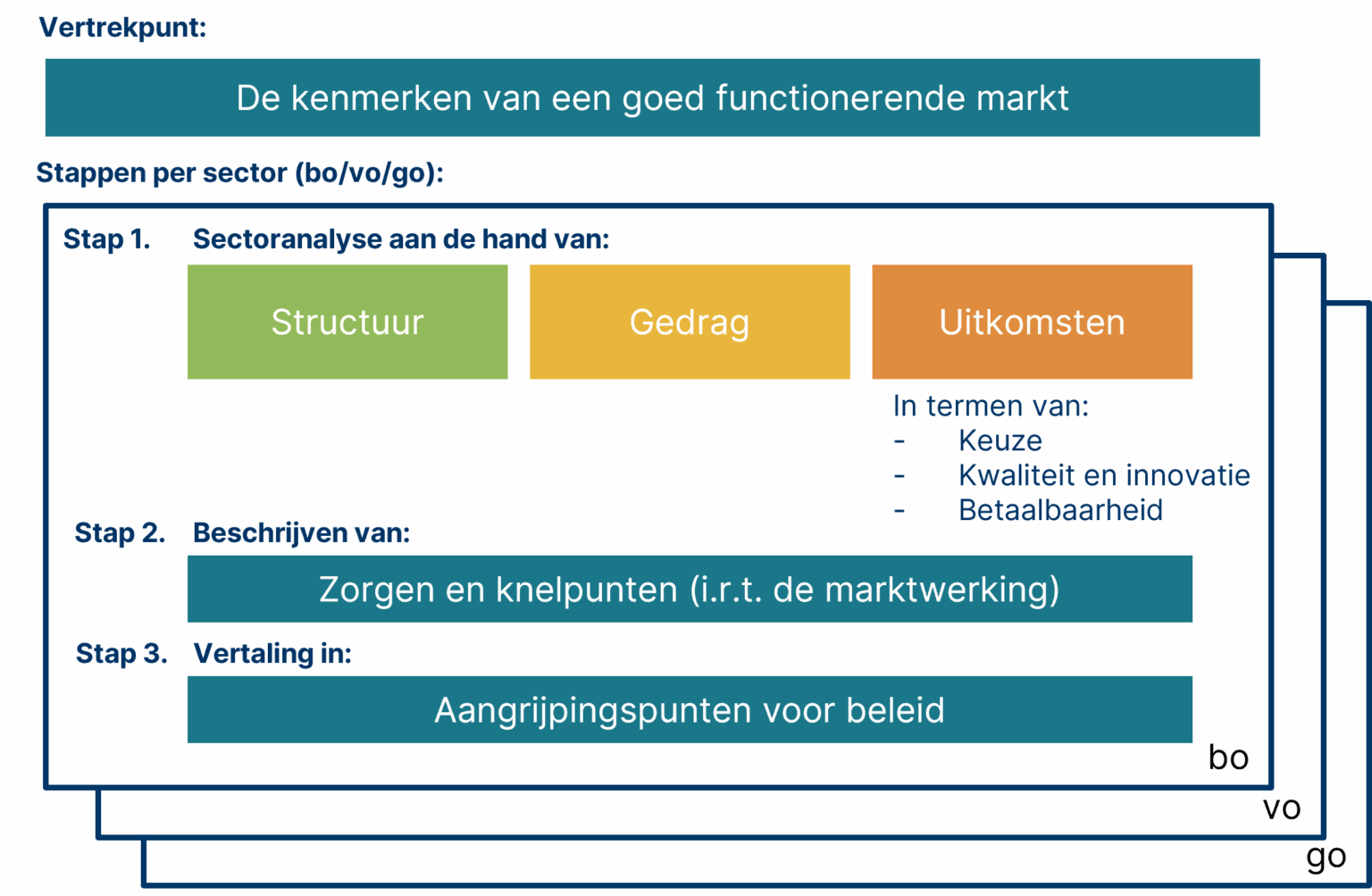
Key findings per sector
Our analyses revealed different images for each education sector:- Secondary education (vo): the educational resources market in secondary education functions reasonably well – there is an adequate supply and the didactic and functional quality is generally perceived as good. However, the market operation needs improvement in terms of switching dynamics, flexibility in offering forms, sustainability, and transparency regarding prices and costs. We believe that opportunities for improvement primarily lie in strengthening the demand side and enhancing cost awareness, not in direct market regulation.
- Primary education (bo): the educational resources market in primary education works well in terms of content – schools are mostly satisfied with quality and user-friendliness. However, market operation is weak due to limited flexibility (emergence of learning packages), low price incentives, and strong dependence on a few suppliers and publishers. Improvements mainly require institutional adjustments on the demand side, rather than direct market regulation.
- Specialised education (go): the educational resources market for specialised education faces a structural risk of market failure due to its small scale and diverse, often student-specific needs. While this market could benefit partly from generic measures in primary and secondary education, targeted public support is necessary to ensure suitable, flexible, and high-quality offerings.
Policy Implications
The policy implications identified in the research are categorised by education sector and grouped around three main themes:- Enhancing the demand side: Professionalising procurement and decision-making processes in schools and boards.
- Increasing transparency: Providing more insights into price formation and cost developments.
- Promoting flexibility and sustainability: Encouraging modular offering forms.